Wednesday, October 24, 2012

survival skill: mustardy vinaigrette

I am trying to remember exactly when vinaigrette stopped being a mystery. It was one of those pivotal junctures in personal history that came long after the first Pesto (1988) - and still a few years after mesclun salad mix (1993: oh, the revelation of Arugula!), and probably a decade before I got Pie Crust. The early days of food history were mainly about acquiring tastes, and I acquired my taste for the french vinaigrette on Sunday mornings as a college student in Northampton, Massachusetts. Brunch at Curtis and Schwartz was Sunday's analogue to Saturday's bar scene -- all the same women, except with bed head -- sharing pitchers of hazelnut coffee in seating arrangements that answered any questions you might have had the night before. Besides the coffee, all I remember is 1) Eggs scrambled with lox and cream cheese, and 2) salad with tarragon vinaigrette.

It was a few years of trying before I managed to replicate that Vinaigrette. First, I had to get past the nineties' obsession with balsamic. But still, my vinaigrettes always came out so oily, no matter how meticulously I followed a recipe.

And then, magically: the French Vinaigrette appears in memory. Almost like an archetype - I don't know quite where from, but it could have been anywhere since the basic formula stays the same:

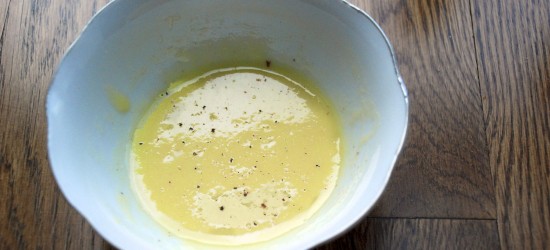
1 part Dijon mustard + wine vinegar
3 parts oil

Just remember the ratio between acid and oil of 1:3. Or to be a lot more specific:

1/4 cup white-wine vinegar
2 tablespoons finely chopped shallot
1/2 teaspoon salt
1/2 teaspoon Dijon mustard
1/4 teaspoon black pepper
3/4 cup oil (olive, or grapeseed, or canola, or a mix)

The shallot is optional. Put everything except the oil into a lidded jar and shake it up. Then add the oil and shake it again until you get a nice emulsion.

Sunday, October 14, 2012

re: dream / scape


re: dream / scape asks:  "What's going on at Alvarado Urban Farm? How can we be a part of it? Add your voice: How would you re-dream Albuquerque's inner-space? Ask a question, upload a photo, offer a possibility."


Saturday, October 13, 2012

The Alter Bahnhof Video Walk

Hi All---

Here is a link to the video walk that I mentioned in response to Honsa & Shynoke's foraging project:

Janet Cardiff & Georges Bures Miller - Alter Bahnhof Video Walk - 2012
http://www.cardiffmiller.com/artworks/walks/alterbahnhof_video.html


The Alter Bahnhof Video Walk was designed for the old train station in Kassel, Germany as part of dOCUMENTA (13). Participants are able to borrow an iPod and headphones from a check-out booth. They are then directed by Cardiff and Miller through the station. An alternate world opens up where reality and fiction meld in a disturbing and uncanny way that has been referred to as "physical cinema". The participants watch things unfold on the small screen but feel the presence of those events deeply because of being situated in the exact location where the footage was shot. As they follow the moving images (and try to frame them as if they were the camera operator) a strange confusion of realities occurs. In this confusion, the past and present conflate and Cardiff and Miller guide us through a meditation on memory and reveal the poignant moments of being alive and present.

Monday, October 8, 2012

Drift / Dérive


I go on walks in the city with the intention of observing and documenting instances where designed systems meet unplanned, or spontaneous systems. 

I approach this kind of like a dérive – in the sense that I don’t set out on a predetermined trajectory. I either have a specific phenomenon that I am drawn to (like the acequias), or I set out to look for new ones.

-Gives me something productive to apply my hyper-awareness to
- Helps me discover and identify instances of unplanned, spontaneous occupation of space – which feeds into some of the themes that I am looking at in my own work
- This in turn cultivates my sense of HOPE  - because I don’t always have much faith in conventional planning. 

Here is how I go about it - I invite you to try it out : 

In silence


- Observe what the main designed elements are (buildings, benches, planters..)

- Look for unplanned, spontaneous systems (anthills, plants growing in the cracks in the pavement, birds nests, un-prescribed behavior… doesn’t have to just be nature VS manmade – could be deviations in expected behavior)

- Do the 2 coexist independently or do they start to blur or form a new, hybrid type of structure?

Photograph or draw what you feel represents this meeting of these 2 systems.


2 apps for urban exploration :


Also of interest - the Los Angeles  Urban Rangers :  Interpretive walks through the city

Psychogeography

Saturday, October 6, 2012

Basic electronics!

The Art of Hardware Hacking by Nicolas Collins (PDF), Chapter 18 is the demo I did in class. 

http://makezine.com/


You can purchase parts in Albuquerque at 'Electronic Parts- 2620  Rhode Island St NE, Albuquerque NM 87110, 1-505-293-6161'


Saturday, September 15, 2012

Dach's contribution


 Okay, third time's a charm.
I'm sure I'll get the hang of this blog eventually. I'm just hopping that this ends up somewhere on this blog and somewhere other than me can read it. I'll worry about getting it to where I want it to go later. Anyway, I just wanted to say that I did work on exercise one, and I'm just waiting to print out the images I picked so I can manipulate them a little more. I also have images from exercise two, which I can share with you now. I decided to take a new twist on the exercise and rather than find technology that's been made obsolete, I looked of things that are a re-imagining of tried and true technological methods. I also found an image that I thought was pretty funny concerning newsboys.


So, this first image is of a sun oven that comes with this food van that sets up camp outside of Hartung Hall on the southwest corner of Central and Stanford. At the time I took the picture, the machine was folded (folded? feld? fold? foldeded? It's 3:30 in the morning, I get a free pass on incorrect spelling and grammar) up, but normally when it's open, it's in this large cone shape with many reflectors inside. I assume, although I've never looked, that there's a solar panel in the middle with a battery or a generator attached to it. This machine is plugged into the actual food van which serves, from what I can tell, New Mexican food on the go.
What interests me about this is that it doesn't make conventional ovens or even fire places and fire pits obsolete. Rather, it's just a reinvention of those things, the new generation of food preparation and heating.


So these two images are of the same little garden plot in someone's backyard. I noticed this as I was walking to school the other day. While gardens for some sort of sustainability are nothing new, it's becoming increasingly rare to see them in a more urban setting (granted, we live in an area that's more suburban than urban, it's still a rare sight).
What I like about this is that it takes the concept of gardening to live rather than gardening for aesthetics (although there most certainly is nothing wrong with the latter) and fits it the need of the individual gardener, rather than the needs of everyone in the neighborhood, although I wonder if these people share the efforts of their hard work with their neighbors.....


As a last minute decision, I decided to use myself as an example. In keeping up with the theme of actual group I was in, I decided to tackle the technology of identity, and how we present ourselves to the world plays a part in that.
I don't know of too many other guys who would proudly wear a pair of tight green pants around in public (I like to call this my Little Mermaid outfit inspired by Ariel, even though it isn't inspired by Ariel and I just think that shade of green and that shade of purple look good together) and I certainly wouldn't have done that three years ago. College has really helped me figure out more about my identity (I actually didn't start going by Dach until my freshman yeah) and expression was a huge part of that for me. I dress more boldly these days and am more confident in myself and in my ability to express myself. I feel as though a lot of people use expression to help shape and show their identities to the world, possibly a change from the how they behaved in middle or high school.


As promised, I am adding a little something concerning newsboys. It's a cute little comic about Disney's Newsies, the Broadway musical based off the Disney movie and how a little girl isn't quite sure what a newsie is, considering we don't have newsboys anymore. I thought it was funny.

Thursday, September 13, 2012

Technology & Obsolescence idea

I might be missing some people...

1. An assemblage of “technology boxes” that flip open to reveal our personal interpretations of the theme. We could all get hold of a cellphone, blender, ipad, camera etc. box with a lid that flips open (we can also reconstruct boxes that don’t). Inside we could collage mind maps, sketches, photographs etc. Perhaps we could lightly spray paint the outside to make them more colorful and/or integrated with each other (yet still see through to the original packaging)....


2. Create a mind map using spark technology. Create a raised surface (pasted with all our notes and images), using a refrigerator box or something into which we could cut out little niches that could hold either twigs (to be rubbed together), oil lamps, wax candles, incandescent light bulbs, compact fluorescent bulbs, or LEDs. Our thoughts about technology and change that deal with the past could be near the twigs and and candles and our thoughts about the present and future could be near the modern bulbs. We could draw heads/brains on top of our notes and around our niches.
See attachment 2-  this could combine all our ideas about change and technology (which as we discussed yesterday, has to do with invention, method, process, and using knowledge to solve a problem)


3. Make a circuit board-like mind map. All our notes, graphs, images in single line form etc. would be in light green (paint?) over a dark green panel with gold or silver points/tacks to highlight important concepts.  

All these ideas (and more are welcome yet perhaps we should solidify something soon?) are just to suggest a structure for some sort of aesthetic cohesiveness.  The content material can be developed by the group once there in El Paso or individually or in smaller groups here beforehand.


One last idea after discussing this with the Italian artist here for ISEA.  Line our panel with notes and such about technology and change/obsolescence, paint in a map of our journey down to El Paso, add boxes (with our without recycled toy wheels-I have a possible source), and fill the box with theme-related objects (receipts, pictures, happy meal toys...) from our trip down.  Each of the real cars heading down can be a team that collects stuff and ideas to place in their designated box.  We could even use our cars in the parking lot to make some kind of statement? 
We could include conversation about the future obsolescence of borders...
This documentation of our trip might tie in well with Ivan and Andres' project.


- Noel

Wednesday, September 12, 2012

Ideas for our wall "panel"...

So today a few of us met up in the Alumni Room on the 3rd floor of the SUB set up by Ian (thank you!) and there was an awesome and very helpful "exchange" of ideas, opinions, and research :) We stayed a little longer and thought that now we've gone through the 'exercises' what are we going to do with them when we get to El Paso??..

We came up with a couple really neat ideas for our gallery space/panel:
One, was to form a collage made of many photos and visually stimulating images. Interpretations would be completely subjective to the viewer in terms of connections drawn between the images...

Another idea, was to form a sort of "mind map"were there would be handwritten and scanned notes, drawings, photos, and even 3D objects. We would use some sort of string to make interpretive connections and not necessarily have to explain why the connection was made. The end product would possibly 'extend' out onto a table/display podium where there could be various objects sitting. We could also pin shelves onto the panel itself that could house an object or two. Also the interpretations could be somewhat formed, but would mostly be subject to the viewer. 

Please, please if you have more ideas..post them :)


P.s. This also brought up the topic of materials to bring to El Paso. Along with your ideas, sketches, research, and objects..what in terms of putting it together what do we need to bring?

Tape, pushpins, string/thread, mylar, markers, paint, etc.????


Sustainability and Transition Group Research

Here are four more links of interest to our Sustainability and Transitions Group:
 
· Here's a group out of East Atlanta GA. It's a recycling program started by a group   of artists focusing on getting local businesses to recycle. Not a lot of info on their Facebook page, but they don't have a website: www.facebook.com/recycle.eav

· Article on the group’s successes and failures from 2009:
http://ecolocalizer.com/2009/12/14/twtc-grassroots-recycling-in-atlanta/


Tiravanija moves art from producing objects to sell to its collectors to sculpt social behaviours. The focus is on people interacting while they are eating, not on the food...--> inspires in the Simple Cake project an opportunity to provide tea and tables where people can sit and chat—opening up space and offering the opportunity to interact with one another in real time.

·         Warehouse 508: http://warehouse508.org/


Warehouse 508 by NMX Sports is a youth-focused, youth-driven avenue to introduce, develop and professionally implement skills in the arts, music, outdoor recreation and nontraditional sports through mentorships, lifestyle events and entrepreneurial opportunities to enhance New Mexico youth’s quality of life and community involvement in a safe, structured and supervised environment.

Sustainability and Transition Group Research

Here are four more links of interest to our Sustainability and Transitions Group:
 
· Here's a group out of East Atlanta GA. It's a recycling program started by a group of artists focusing on getting local businesses to recycle. Not a lot of info on their Facebook page, but they don't have a website: www.facebook.com/recycle.eav

· Article on the group’s successes and failures from 2009:
http://ecolocalizer.com/2009/12/14/twtc-grassroots-recycling-in-atlanta/
This project is of interest to us, because it was a group of artists who researched recycling centers that would their need.  They raised the money themselves and got the community interested in working on this problem.

-Irene

Tuesday, September 11, 2012

Exercise 3 STUFF

Post research components here:

Exercise 2 STUFF

Post Photos, Images, and Objects (?) here:

Exercise 1 STUFF

Post Photos/Images here:

Open Virtual Storage Space (for our stuff)

After meeting and greeting Ivan Puig at the museum on Sunday, which was awesome by the way, our class was given assignments and parameters for a piece that will contribute to the installation of the SEFT 1 project at UTEP. 

Hopefully you were as excited and equally nervous about this opportunity as I was (am). Seeing as we don't have organized parameters for getting, sending, and brainstorming ideas I thought this simple blog would allow access to ideas, if we cannot physically have a meeting..

So please post photos, scanned whatevers (sketches, text, 3D objects, etc), and just blurbs or ideas that you may have. This should be a collection of everything we are thinking about and/or researching. 

Everything is completely open. So feedback, please! :)

Good luck, and GO CC!


Sustainability and Transition Group Research

Good evening!
Here is the first go at articulating what our group is all about:

Sustainability and Transitions

Our group’s topic is Sustainability and Transitions.  Specifically, we have been discussing sustainability of the arts, as well as more sustainable practices in food preparation and waste management.  We have interpreted the transitions portion of our focus in terms of transitioning from unsustainable practices to more sustainable practices through processes such as reskilling.  Of particular interest to us has been the nature of transactions—in particular, finding ways to engage people in exchanges that go beyond the mechanics of mere financial transactions.  We are planning to engage participants in sampling simple foods and making interactive on-site art objects at two local farmer’s markets in the coming weeks.


Our Group Members are as follows:

·         Jan “Honza” Turnovsky          tur@unm.edu

·         Noah Kessler                           noahk@unm.edu

·         Irene Loy                                ireneloy@unm.edu

·         Rob Nakai                               knockeye@gmail.com


Our Links on Existing Projects to share with the class are as follows:
* The Permaculture Project LLC: www.permacultureproject.com 
* Ampersand Sustainable Learning Center: www.ampersandproject.org
Stay tuned for more!
Cheers, Irene